A monthly figure looks manageable until you add up what sits behind it — interest, deposit, balloon payments, and a van that may need four new tyres before the end of the year.
This page breaks down what used vans on finance near me actually costs in 2026, what the agreements look like in practice, and what we see go wrong when buyers focus on the payment and miss everything else. We’re based in Haydock, St Helens, and most of what follows comes from conversations on the forecourt.
What does the monthly figure on a used van finance deal actually include?
The monthly figure covers the loan repayment — principal plus interest — and nothing else. It does not include insurance, road tax, fuel, tyres, servicing or any repair that falls outside a warranty. On a typical used van priced between £8,000 and £18,000, with a 10–20% deposit and a 36–48 month term, monthly payments vary considerably depending on the APR you are offered and the deposit you put down. The rate a lender offers you depends on your credit file, income and the age of the van — buyers with a clean file and a solid deposit will pay meaningfully less over the term than those who put the minimum down and carry any credit history. That gap in total interest paid is the number most people do not see on the forecourt.
Which finance type suits a working van buyer?
There are three agreements you will be offered on a used van: Hire Purchase (HP), Personal Contract Purchase (PCP), and a straightforward personal loan from your bank. For a working buyer, HP is usually the most straightforward. You pay a deposit, make fixed monthly payments, and own the van outright at the end. No mileage cap, no condition inspection, no balloon payment to find.
PCP keeps the monthly payment lower by deferring a chunk of the cost — the Guaranteed Minimum Future Value — to the end of the term. That sounds useful until you want to keep the van. You either pay the balloon (often £3,000–£6,000 on a mid-range panel van) or hand it back. For a sole trader who puts 25,000 miles a year on a van, handing it back in acceptable condition is rarely straightforward.
A bank loan gives you the same outcome as HP — you own the van from day one — but the rate depends entirely on your personal credit score, and unsecured loan rates on amounts under £10,000 can be significantly higher than dealer-arranged HP. Compare what your bank quotes against a dealer-arranged HP deal before you assume the bank is the sensible option — the difference in total interest paid over a 48-month term can be substantial.
If you are VAT-registered, HP interest is not reclaimable, but the capital element of each payment may qualify for capital allowances. A personal loan offers no VAT benefit at all. Talk to your accountant before you sign — the tax treatment of van finance is genuinely worth an hour of their time.
| Model | Payload (kg) | Load Volume (m³) | MPG (combined) | Used Price Range (2026) | Euro Standard |
|---|---|---|---|---|---|
| Ford Transit Custom (2016–2020) | 1,000–1,170 | 5.2–6.0 | 34–40 | £9,000–£18,000 | Euro 6 |
| Vauxhall Vivaro (2015–2019) | 900–1,100 | 5.2–6.1 | 35–42 | £7,500–£14,500 | Euro 6 |
| Renault Trafic (2015–2019) | 900–1,100 | 5.2–6.1 | 36–42 | £7,000–£14,000 | Euro 6 |
| Ford Transit (2016–2020, MWB) | 1,200–1,500 | 8.0–11.0 | 28–34 | £10,000–£19,000 | Euro 6 |
| Mercedes-Benz Vito (2016–2020) | 900–1,050 | 5.5–6.6 | 34–40 | £11,000–£20,000 | Euro 6 |
| Vauxhall Movano (2015–2020) | 1,300–1,700 | 10.0–14.0 | 27–33 | £9,000–£17,000 | Euro 6 |
What payload and load volume do you actually need before you finance anything?
Finance locks you in for two to four years. Getting the van wrong at the start costs you every month of that term. Payload and load volume are the two numbers to fix before you look at a single monthly figure.
A small van — Citroën Berlingo, Vauxhall Combo, Ford Transit Connect — typically carries 600–800 kg and offers 3.3–3.9 m³ of load space. That is enough for a sparky’s kit or a plumber’s parts run, not for roofing materials or bulk deliveries.
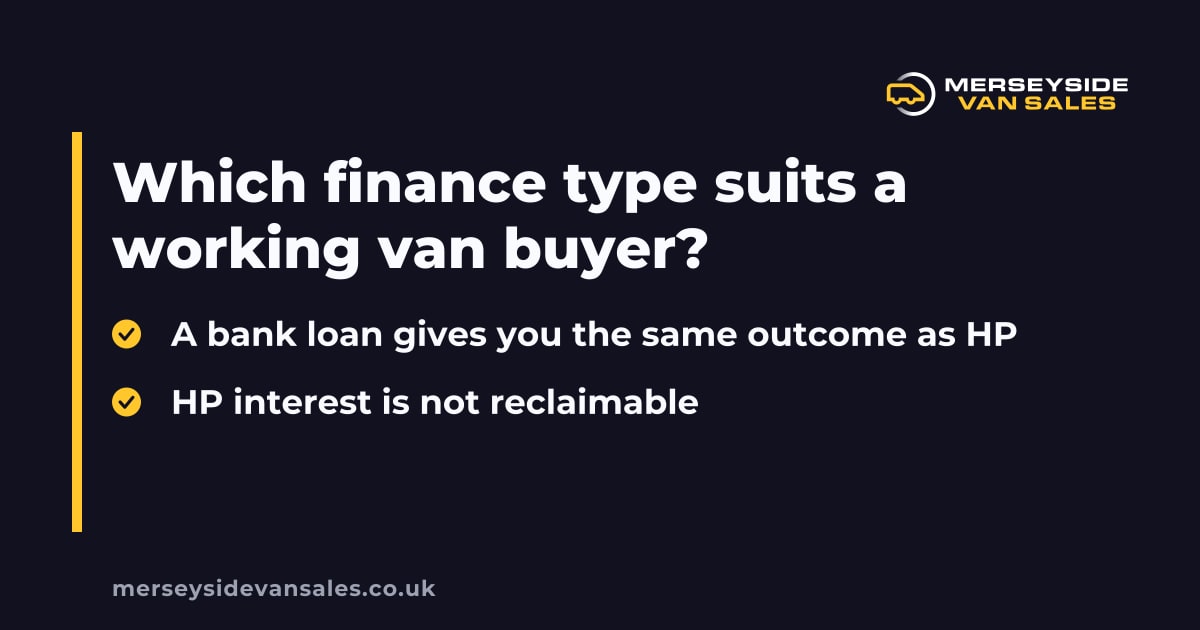
A medium van — Vauxhall Vivaro, Renault Trafic, Ford Transit Custom — carries 900–1,200 kg with 5.2–6.0 m³ of space. This is the van most sole traders in the North West actually need, and it is the segment that sells fastest on our forecourt.
A large panel van — Ford Transit, Vauxhall Movano, Renault Master — carries 1,200–1,700 kg with 8.0–14.0 m³ of space depending on roof height and wheelbase. Payload matters legally too: exceed it and your load becomes an insurance and liability issue. Check the plate on the van’s door sill, not the brochure.
What faults should you price in before you commit to a monthly payment?
A used van that fails its MOT two months after you finance it does not pause the monthly payment. The repair bill sits on top. Knowing what fails by model and age is part of the real cost calculation.
Ford Transit Custom (2013–2019, 2.0 TDCi): the EGR cooler and DPF are the two most common failures on high-mileage examples. An EGR cooler replacement typically costs £400–£700 fitted. A DPF clean is £150–£300; a full replacement is £800–£1,500. Turbos on the 2.0-litre engine are a known weakness above 100,000 miles — budget £900–£1,400 fitted.
Vauxhall Vivaro and Renault Trafic (2014–2019, 1.6 BiTurbo): the twin-turbo setup is the van’s weak point. Low-pressure turbo failure is common on vans that have been serviced late. Replacement costs £600–£1,200. Injector seals leak on higher-mileage examples, and a full injector replacement set runs to £1,200–£2,000.
Mercedes-Benz Vito (2015 onwards, 2.1 CDI): injector return pipes corrode and leak, which is a £200–£400 fix but one that gets missed until the van starts smoking. AdBlue system faults are increasingly common on post-2016 examples — a NOx sensor is around £200–£400 fitted.
These are not reasons to avoid the vans. They are reasons to factor the cost into what you are willing to pay monthly, and to ask what warranty covers the van you are financing.
How does your credit file affect what you are offered — and what can you do about it?
Lenders look at four things: your credit score, your income and affordability, how long you have been at your current address, and whether you have any County Court Judgements or defaults in the last three years. A sole trader with variable income is not automatically a bad risk, but you may need to show bank statements for the last three to six months rather than a payslip.
The rate you are offered depends on your credit file, and the difference between a clean file and one with recent marks can be several percentage points of APR — which adds up to real money over a 36 or 48-month term. Check your file before you apply, not after. Experian, Equifax and TransUnion all offer free statutory reports. Errors on credit files are more common than people expect, and a corrected file can shift the rate you are offered meaningfully.
If your credit file has marks on it, be aware that recent defaults or a CCJ will narrow your lender options significantly, and some mainstream lenders will decline outright. Multiple finance applications in a short period each leave a hard search on your file, which lenders treat as a warning sign. One well-prepared application is better than three speculative ones. We run a soft search first where possible, which does not affect your score.
What this means if you’re buying in Merseyside
We take in part-exchanges from builders, couriers and sole traders across St Helens, Wigan and Warrington every week. The vans that come in on finance settlements tell us something useful: the ones that have been stretched — a medium van doing the work of a large one, a high-mileage Transit Custom financed at the top of someone’s budget with nothing left for tyres — are the ones where the buyer is relieved to be handing the keys back rather than sad to see it go.
The medium vans — Transit Custom, Vivaro, Trafic — are what sells in a fortnight here. Large panel vans sit longer, usually because the buyer who needs one has already done the sums on fuel and road tax and decided to wait for the right example rather than finance the first one they see. That is the right call. A 2.0-litre large van doing 28 MPG at current diesel prices costs meaningfully more per year to run than a medium van doing 38 MPG — the difference over a 48-month finance term is real money.
If you are looking at used vans on finance near Haydock or anywhere across Merseyside, come and see what we have in. We would rather spend twenty minutes on the forecourt working out what you actually need than have you finance the wrong van.
Common questions
Yes. Lenders assess affordability rather than employment type. You will typically need three to six months of bank statements showing consistent income. Some lenders ask for a self-assessment tax return. Being self-employed does not disqualify you, but variable income means the affordability check takes longer than a PAYE application.
Most lenders require 10% of the purchase price as a minimum deposit. Putting down 20–25% reduces your monthly payment and the total interest you pay over the term. On a £12,000 van, the difference between a 10% and 20% deposit is roughly £30–£40 per month and several hundred pounds in total interest.
A used medium van with a 1,000 kg payload — Transit Custom, Vivaro or Trafic — typically costs £7,500–£14,500 in 2026. With a 15% deposit and a 48-month HP term at 12.9% APR, monthly payments fall roughly between £175 and £340. The lower end buys older or higher-mileage stock.
It will show on your credit file as a credit commitment, which lenders count against your affordability when you apply for anything else. A well-managed van finance agreement paid on time generally improves your credit score over the term. Missed payments do the opposite and stay on your file for six years.
On an HP agreement, yes — most allow early settlement and you pay a reduced interest figure. Under the Consumer Credit Act you can settle after paying 50% of the total amount payable and return the van with no further liability. Check your agreement for any early repayment charge before you arrange a settlement.
Service history, MOT history via the DVSA checker, and a vehicle provenance check for outstanding finance, write-off markers and mileage discrepancies. Also check the payload plate on the door sill matches what you need. A van with hidden outstanding finance transfers that liability to you on purchase — the check costs around £10 and is not optional.
Related reading
- Van guides
- Van Finance Explained: The Easiest Way to Own Your Next Workhorse
- What September’s Finance & Tax Updates Mean for Van Buyers
Looking for your next van?
You are spending your own money on a van you need to work from Monday. We hold a range of used panel vans at our Haydock site in St Helens — medium and large, Euro 6, with service history — and we can talk through finance options without a hard credit search until you are ready. Come and have a look, or call us and we will tell you what we have that fits your payload and your budget.
Browse our used vans for sale in St Helens →
Talk to us: 0151 272 0326 · WhatsApp · Email
Follow us: 


Merseyside Van Sales Ltd is authorised and regulated by the Financial Conduct Authority (FCA no. 1007141). We act as a credit broker, not a lender, and can introduce you to a limited number of finance providers. Representative 11.4% APR. Finance is subject to status and is only available to UK residents aged 18 and over.